
One of the most common questions I hear from buyers who are under contract on a new construction home is some version of this: "The builder is offering me $10,000 in closing costs if I use their lender. Should I just take it?"
The honest answer is: it depends — and the decision is worth more than a few minutes of thought.
Here is what I tell every buyer I work with before they make that choice.
Thinking about buying new construction?
Get expert guidance on builders, incentives, and contracts — no pressure.
What Is a Builder's Preferred Lender?
Most major builders in Northern Colorado — D.R. Horton, Lennar, Meritage, Century Communities, KB Home, and others — have a financial relationship with a specific mortgage company. Sometimes the lender is a subsidiary they own. Sometimes it is a preferred partner they have worked with for years.
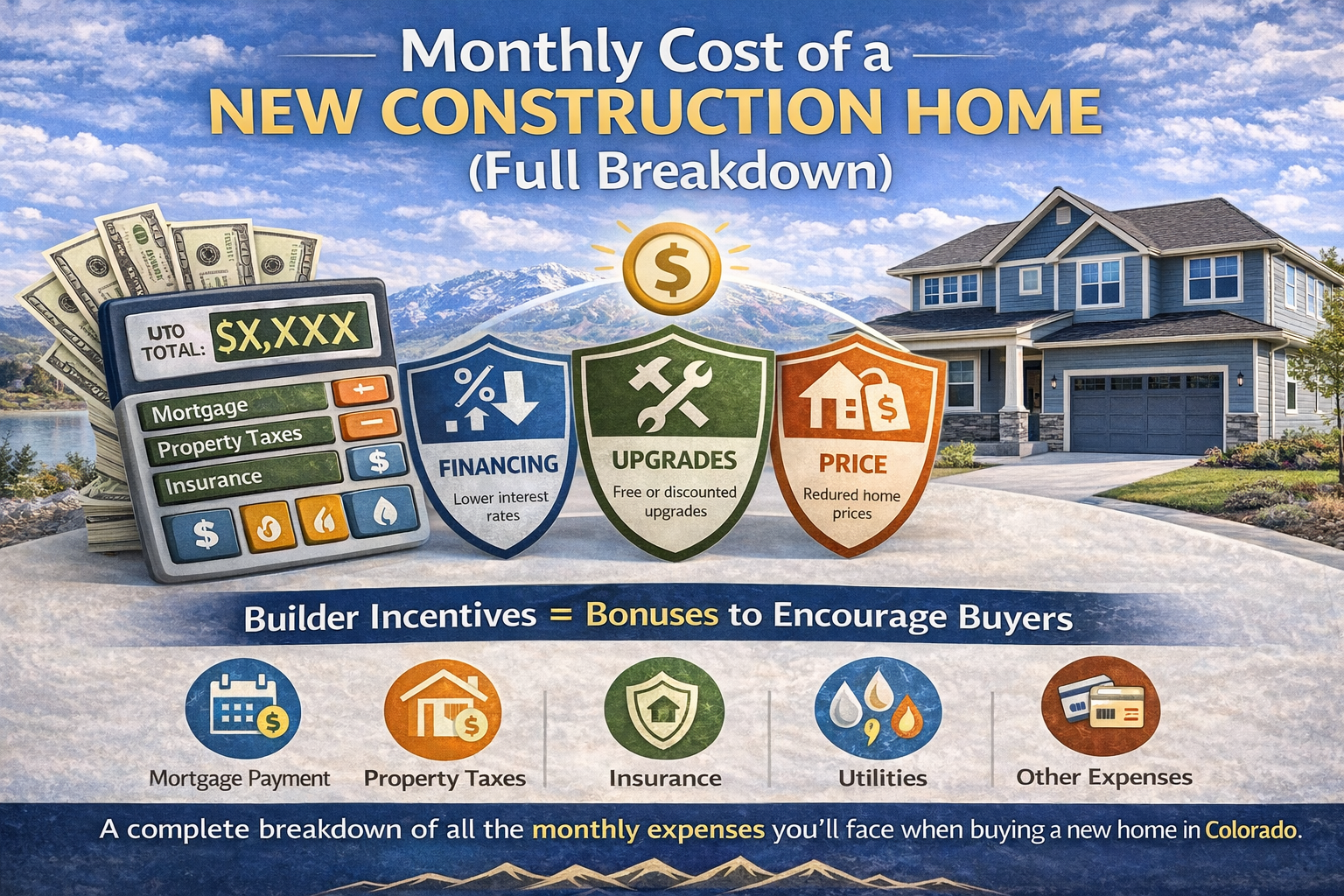
The builder's sales team will typically introduce you to this lender early in the process and offer incentives to use them. Those incentives are real. They can include rate buydowns, closing cost contributions, or both.
The question is not whether the incentives are real. The question is whether using the builder's lender is the best overall financial decision for your situation.
What Builders Are Currently Offering in Northern Colorado
To give you a concrete sense of what these incentives look like right now, here are two examples from builders active in Northern Colorado:
Century Communities is currently offering a rate buydown to 3.375% (4.225% APR) for the first five years when buyers finance through their affiliate lender, Inspire Home Loans. This is an adjustable rate structure — important to understand before committing.
Meritage Homes has offered similar rate buydown programs tied to MTH Mortgage, their in-house lending arm. Their incentives often include both a rate reduction and closing cost assistance, but the terms require using their preferred lender and title company.
These are not small offers. A meaningful rate buydown in today's market can save a buyer hundreds of dollars per month in the early years of the loan. That matters.
The Real Question: Is the Incentive the Best Deal Available?
Here is where buyers sometimes make a mistake. They see a $10,000 closing cost credit or a rate buydown and assume that automatically makes the builder's lender the right choice. But the full financial picture is more complicated than that.
Things to compare before deciding:
The interest rate over the full loan term. A rate buydown for the first five years sounds attractive. But what happens in year six when the rate adjusts? If you plan to stay in the home long-term, the fully indexed rate matters more than the teaser rate.
The loan origination fees. Some builder-affiliated lenders offset the incentive value through higher origination fees or points. Ask for a full Loan Estimate — a standardized document lenders are required to provide — so you can compare apples to apples.
Whether you can use the incentive with a different lender. Sometimes the answer is partially yes. Some builders will allow a portion of their incentive to be applied even if you use an outside lender. Always ask.
Your long-term plans. If you are planning to refinance within two to three years, the short-term incentive may be more valuable than the long-term rate. If you are planning to stay in the home for fifteen years, you want the best thirty-year rate you can get.
What I Recommend to Every Buyer
Get at least one outside quote before deciding.
This is not a knock on builder-affiliated lenders. Some of them are genuinely competitive. But you will not know that unless you compare. Getting a Loan Estimate from an independent lender takes a day or two and costs you nothing.
If the builder's lender wins on the full comparison — rate, fees, incentives, and long-term cost — then take it. If an outside lender is meaningfully better even after accounting for the incentive, the math will show you that clearly.
The goal is not to avoid the builder's lender. The goal is to make an informed decision rather than a reactive one.
Watch Out for These Common Situations
The incentive disappears if you switch lenders after going under contract. In most cases, if you start with the builder's lender and then switch to an outside lender mid-transaction, you forfeit the incentive entirely. Make your decision early and commit to it.
Builder contracts sometimes have financing deadlines that favor their lender. If the builder's lender can process your loan faster than an outside lender, that can matter — especially if there are tight closing timelines. Ask both lenders about their expected timelines before deciding.
The rate buydown may be tied to a specific loan type. Some incentives apply only to FHA loans, only to conventional loans, or only to ARM products. Make sure you understand exactly which loan you are being offered before comparing it to outside quotes.
How a Buyer's Agent Helps With This Decision
One of the most practical ways I help buyers during the financing process is by making sure they are comparing correctly. I have seen buyers accept incentives that seemed large and later realize the long-term cost of the loan offset the benefit. I have also seen buyers walk away from legitimate builder incentives because they were focused on the wrong numbers.
Having someone on your side who understands how builder contracts, financing deadlines, and incentive structures work together can make this decision significantly clearer.
The Bottom Line
Builder preferred lender incentives are worth taking seriously. They can provide real value — sometimes thousands of dollars in savings at closing or meaningfully lower payments in the early years of your loan.
But "take the incentive" is not automatically the right answer. The right answer is to compare the full financial picture — rate, fees, loan type, and long-term cost — before committing.
If you are currently under contract on a new construction home in Northern Colorado and trying to work through this decision, I am happy to talk through the specifics. Every builder and every situation is a little different.
Mark Leavitt — NoCo New Builds | The Nixon Team at RE/MAX Alliance (970) 590-9656 | Mark@noconewbuilds.com